Friday, June 29, 2012

Wood Duck Conservation Status

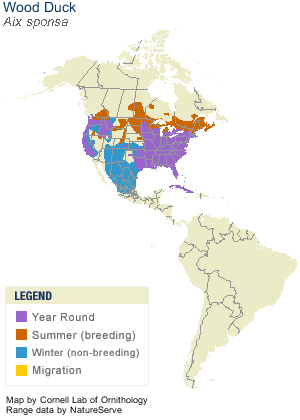
Currently all members of Anatidae in Eastern N.A. are not endangered, however this was not always the case. In the late 1800's to early 1900's the Wood Duck was near extinction. At the time Wood Ducks inhabited dense woodlands, slow flowing creeks, secluded pools and marshy ponds in North American Forests. Much of these forests were lost at the turn of the century. Drainage and logging wiped out swamps and the large hollow trees that were used for nesting. Wood ducks were the most hunted waterfowl prior to 1918. They used to be stuff and displayed in homes and their feathers were used as lures for trout fishing.

However, in 1918 the Migratory Bird Treaty Act was made law and that prohibited the hunting of Wood Ducks nationwide. This ban lasted for 23 years until populations recovered around 1941. Being able to survive close to human settlements has greatly helped the ducks due to a widespread nest building project. These artificial nests have helped Wood Duck populations recover by giving them more places to nest. Currently the Wood Duck is a common bird and is not endangered.

Current Wood Duck range map.

Sources

Wednesday, June 27, 2012

Reproduction

Wood Duck - Family Anatidae
       The Wood Duck displays its true colors in spring. Males attract females with their extravagant plumage, while female attract males with a vocalization cue. Mutual preening initiates the display and males also raise and move wings and tails frequently to display his colors to the female. They are monogamous for at least one breeding season.
       They nest alone in trees about 3-50 feet high and it's usually close to a body of water. The Wood Duck nests in a cavity found in the tree, sometimes in Pileated Woodpecker holes, and lines it with wood shavings and down feathers for insulation.
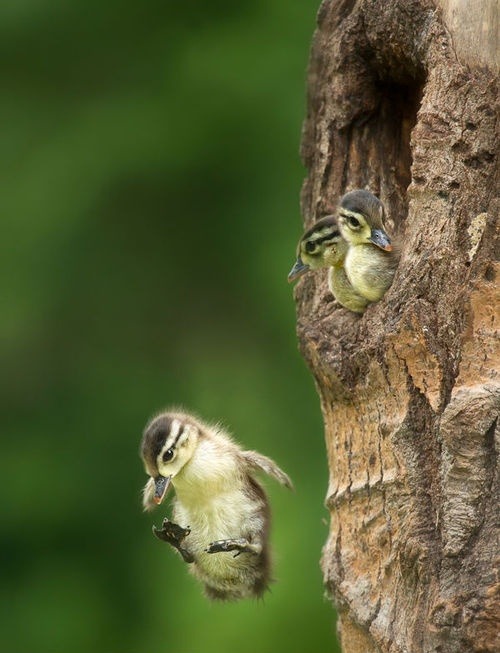
          The clutch size is about 10-15, with a survivorship of 75%. Sometimes two females share the same nest and take terns incubating the eggs. This is termed a "communal nest". After 30 days the precocial ducklings hatch and the next day they leave the nest in an interesting manner. At the call of the mothers voice, each chick jumps from the nest to the ground or water. Some jump from a height of 60 feet and they all land unscathed. After about 9 weeks the ducklings can fly and become independent. Wood ducks regularly produce two broods in one breeding season. It takes one year for a chick to reach sexual maturity, giving the Wood Duck a fast life history.


Wood Duck duckling leaping from its nest. 
by Stan Tekiela
Sources


Southern Screamer - Family Anhimidae
       Southern Screamers, found in South America, are monogamous and form pair bounds that last for a few years and up to their entire life (~15 years). Courtship displays involves mutual preening and dueting. Dueting consists of loud calls by both sexes which can be heard up to two miles away. They will also moved their head back so that it touches their back. 
        For a nest, the couple build a large platform nest made out of reeds, straws and sticks, on the ground and near shallow water. The female lays 2-7 white eggs, while both male and female incubate the eggs for a period of 43-46 days. The prococial chicks are cared for about 12-14 weeks, while fledging happens at about 8-10 weeks. They are also very good swimmers. The Southern Screamer lifetime is about 15 years which is a slow life history.



Thursday, June 21, 2012


Today at Dekorte Park in the Meadowlands I saw a few dozen of Mallards. While on the water they were very quiet but as I approached they started to swim away. When I really close to a pair, they flew away. As they took off one made the two syllable sound "Wahck-wahck" and it said that again when landing. It sound like a typical duck sounding call. The mnemonic I came up with was "Good-bye" and "Hell-o". The pair landed next to about 8 other Mallards and they and few immediately started to call out "wahck-wachk-wachk-wachk-wachk-wachk-wachk..." for about 10 seconds and then they stopped. 

Tuesday, June 12, 2012

Anseriformes Characteristics

I will focus here on Anatidae since that is the only family in Eastern NA.

All Anatids have several distinguishing characteristics that make them easy to identify to family. These include:

  • A large and somewhat flattened bill
  • Medium to large birds with a broad body
  • Partially Webbed feet
  • Predominantly brown, black, white, and metallic green colors.
Some species share a hard process or "nail" at the tip of their bill, a large preen gland, long necks, and a large external penis in males. 

The shape of the bill is perfectly shaped for each individual species diet. Most geese are herbivorous and their bill is wide, flat and strong to grasp vegetation. Ducks that feed by filtering water like Shovelers, have a broad spatula-like bill to increase straining efficiency. The "nail" in filters and dabbling feeder is small because they do not need it to obtain food. Mergansers, whose diet is only fish, have a narrow serrated bill. This allows them to hold on to slippery fish.

Most Anatids are strong fliers and have powerful pectoral and supracoracoideus muscles. 

Males Anatids have a penis. Unlike mammals, sperm does not flow through the central canal, but through the grooves along the outside. The shape is long and twisty, like a cork-screw

The colors of Anatid plumage differs greatly from species and contains a wide variety of colors. There are also  curled hoods, like on the muscovy duck, and crests like on mergansers

Flight feathers are molted once a year. All feathers are lost simultaneously so the bird cannot fly during this short period of time. Contour Feathers are molted twice per year.